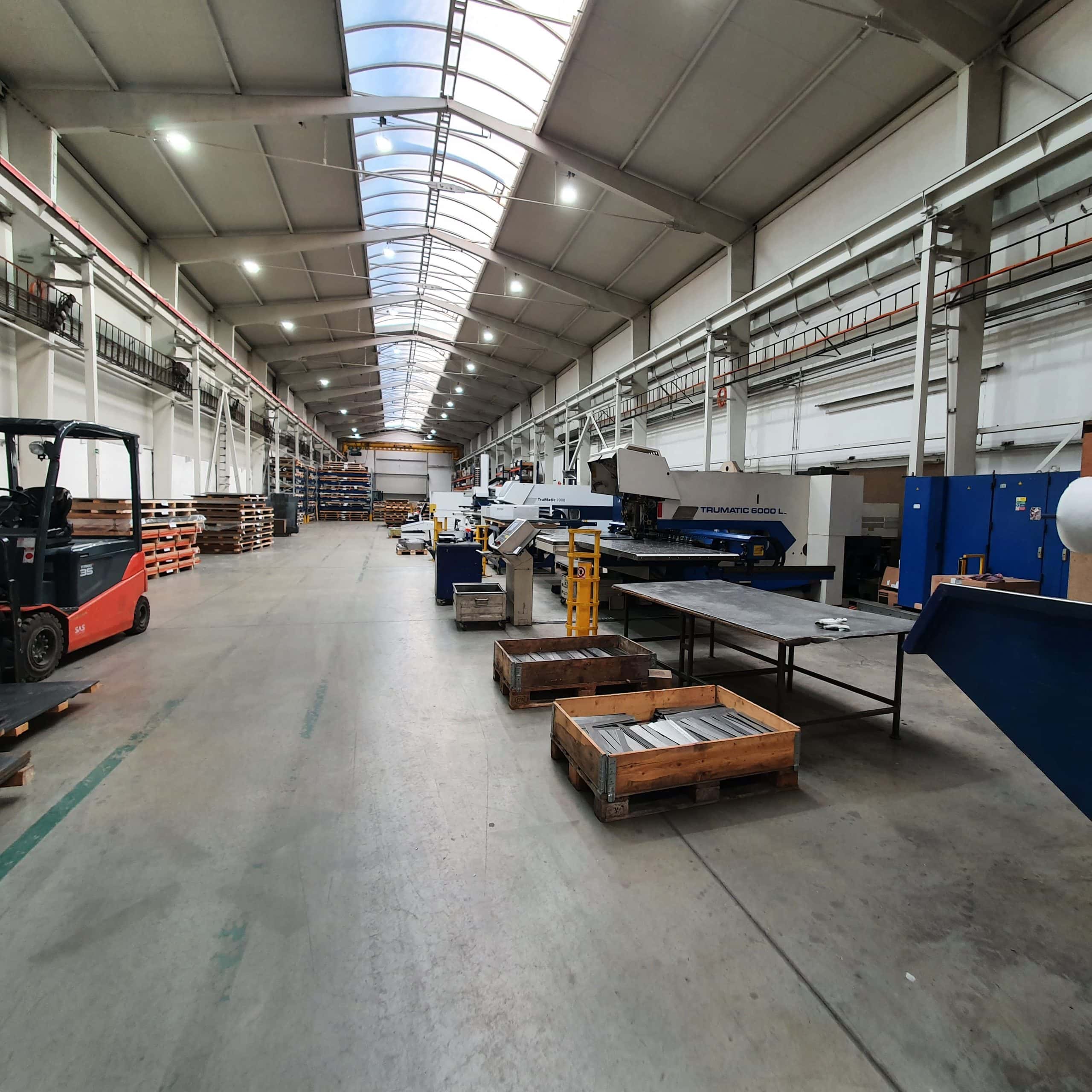
Our sheet metal forming services
In forming, the geometry of a metal workpiece is changed by plastic deformation. In contrast to separating processes such as laser cutting, the material is shaped rather than selectively removed.
Which forming technology is suitable depends on the component shape, material, material thickness and the quantity required.
CNC press braking and bending
CNC press braking produces defined angles, profiles, covers and other bent parts from flat sheet metal blanks. This process is particularly suitable for components with straight bending lines.
If you need such components, you will find all technical information on our dedicated page CNC press brake bending and sheet metal bending.
Formed parts with complex geometries
In addition to simple bent parts, designs may require additional formed elements or more complex geometries.
These include, for example, stiffening ribs, beads, embossings, flanges or other formed areas. Such requirements must be assessed separately on the basis of the drawing, tooling requirements and available manufacturing capabilities.
The mention of a process does not mean that every desired geometry can be realised without additional tooling.
Combining manufacturing processes
Many formed parts require additional processing steps before or after forming.
Depending on the component, laser cutting, punching, CNC press braking, welding and surface treatment can be requested together.
Custom formed parts for industrial applications
Sheet metal forming is used in many technical components.
Typical component types include, for example:
- Angles and profiles with defined bending geometries
- Stiffening and structural elements
- Housing components and covers
- Brackets, consoles and assembly elements
- Sheet metal parts with multiple forming areas
- Formed parts for subsequent assembly manufacturing
The specific design depends on your drawing and the available tools.
Forming steel, stainless steel and aluminium
Forming steel sheet
Sheet steel is used for structural elements, brackets, housings and other industrial components.
For the technical review, material grade, material thickness, bend radii and degree of deformation are particularly important.
Forming stainless steel sheet
With stainless steel, strength, work hardening and springback behaviour influence the forming process.
If there are special requirements for visible surfaces or finish, these should be taken into account when making an enquiry.
Forming aluminium sheet
The formability of aluminium depends heavily on the alloy and material condition. A geometry that is possible with one alloy does not have to be equally feasible with another.
That is why we need the exact material designation wherever possible.
Design and technical feasibility
In sheet metal forming, the design has a major influence on which manufacturing technology can be used.
Bend radii and material behaviour
Radii that are too small can limit formability. In addition, possible springback and material changes must be taken into account.
Part geometry and tool access
Complex formed features, narrow gaps and multi-stage forming operations may require special tools or manufacturing sequences.
Tolerances and functional dimensions
Important dimensions and permissible deviations should be clearly marked on the drawing. The achievable tolerances are checked according to the process and the component.
Tooling costs and quantity
For tool-dependent forming processes, the required tooling effort is an important cost factor. Whether a particular manufacturing method is economically suitable therefore also depends on the quantity and any repeat orders.
Contract manufacturing of formed parts
With external sheet metal forming, companies can complement their manufacturing capabilities and have customised parts made to drawing on a project basis.
DIVIKOM BlechProfis supports commercial customers in coordinating technical requirements and assessing suitable manufacturing options.
Particularly for components with several operations, it makes sense to consider the manufacturing process jointly.
If you wish, you can also enquire about these services:
You can find further options in our overview of the sheet metal fabrication services.
Request a quote: the information we need
To enable us to assess the technical feasibility of your component, we need information that is as complete as possible.
Please specify:
- Material type and exact grade
- Material thickness and starting dimensions
- Required final geometry
- Important radii, angles and formed features
- Quantity per item and, where applicable, annual requirement
- Required tolerances and functional dimensions
- Special surface requirements
- Further processing steps required
- Delivery date and delivery location
A dimensioned PDF drawing and any existing CAD data make the technical assessment easier. If required, we will agree the suitable method of submission with you.
Request a quote for formed parts


 German
 English