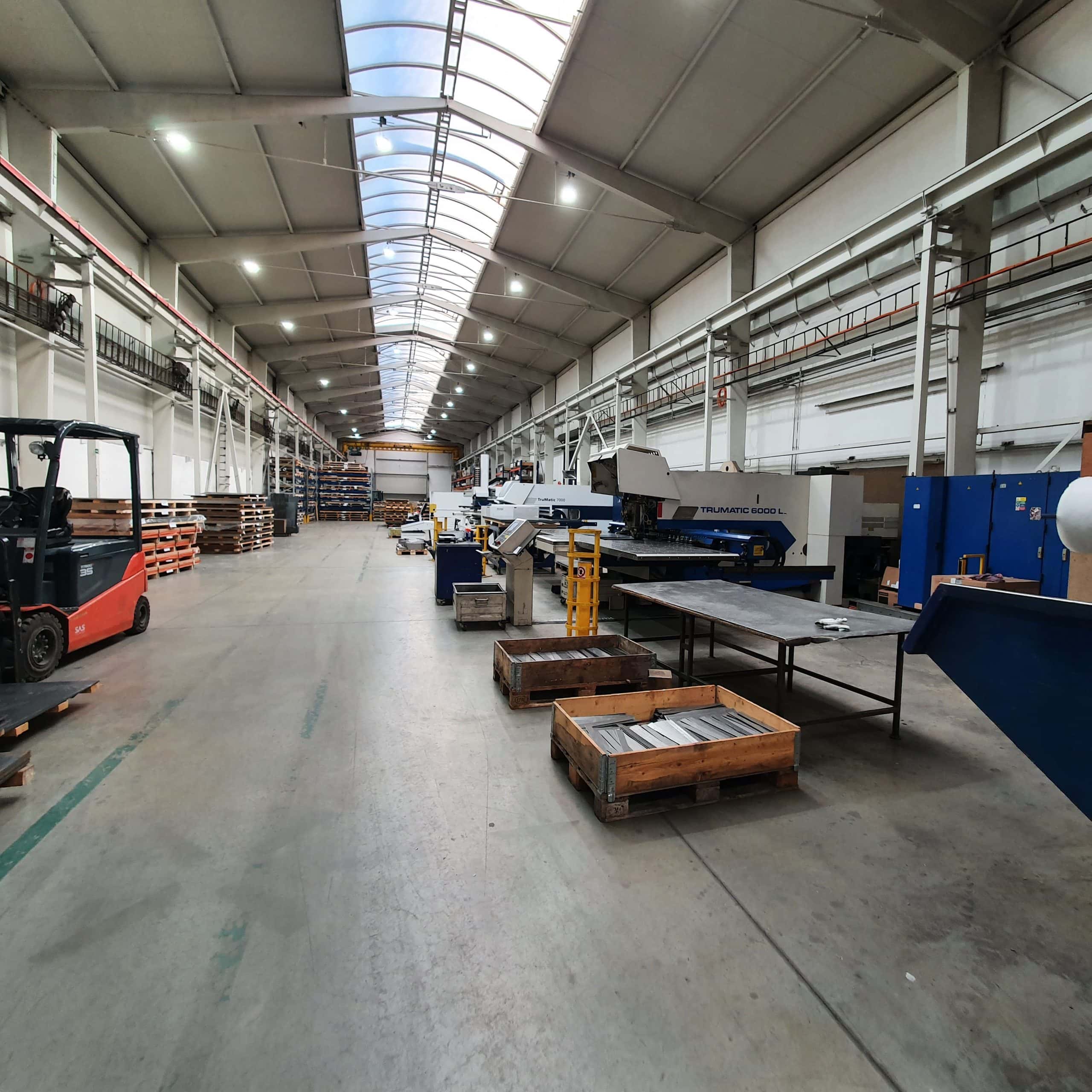
Sheet Metal Bending and CNC Press Brake Forming
Custom bent sheet metal parts made to your drawings
CNC press brake capabilities
Benefits
- Subcontract manufacturing to your drawings
- CNC-controlled press brake forming
- Additional sheet metal fabrication on request
Technical specifications
- Press capacity: up to 170 tonnes
- Bending length: up to 4,000 mm
- ACB angle measurement and 6-axis backgauge
Machinery
- 3x TruBend Cell 5000
- 3x TruBend Cell 7000
- 9x TruBend

The achievable bending length, sheet thickness and geometry depend on the material, required bending force, tooling and component dimensions. We review your drawings before agreeing on the manufacturing requirements and scope of supply. Find out more about our sheet metal fabrication machinery.
Sheet metal bending services
CNC press brake forming shapes sheet metal along defined bend lines. A punch and die form the sheet to the specified bend angles and radii under CNC control.
The process is suitable for simple angles and profiles as well as parts with multiple bends. CNC control supports repeatable production, including repeat orders for identical components.
Our services include:
- CNC press brake forming to drawing: Custom sheet metal components manufactured to your technical specifications.
- Made-to-measure bent parts: Formed profiles, angles, brackets, covers and enclosure components.
- Bent components for industrial applications: Parts for machinery, equipment and engineered structures.
- Subcontract manufacturing: Project-based production and repeat orders, subject to a review of technical and commercial feasibility.
- Combined sheet metal fabrication: Cutting, bending and further processing within the agreed scope of supply.
Your quotation is based on your drawings and required quantities.
Which sheet metals can be bent?
Formability, required bending force and springback vary by material. Suitable process parameters depend on the specified material grade and component geometry.
Steel sheet bending
Steel sheet is used for brackets, structural components, enclosures and other formed parts. Production planning takes account of the material grade, sheet thickness, bend radius and required tolerances.
Stainless steel bending
Stainless steel requires attention to strength, springback and surface finish. Specify visible surfaces, grain direction and any restrictions on tooling marks when requesting a quote.
Aluminium sheet bending
Aluminium is used for lightweight enclosures, covers and structural parts. Its formability depends on the alloy and temper. We therefore assess the proposed geometry and bend radii for each project.
We review your technical documents to confirm whether your steel, stainless steel or aluminium component can be manufactured to the required specification.
Custom bent parts and typical applications
CNC press brake forming can produce a wide range of sheet metal shapes, including:
- L-profiles and angles: Mounting brackets, support brackets and connecting parts.
- U-channels: Guide channels, supports and structural profiles.
- Z-profiles and multi-bend parts: Covers, offset profiles and custom components.
- Enclosures and panels: Enclosure components, side panels and protective covers.
- Brackets and mounting components: Custom parts for machinery and equipment.
- Bent parts for welded assemblies: Pre-formed components for subsequent welding into larger assemblies.
The shapes that can be manufactured depend on the part geometry and available tooling.
For a custom component, send us your drawings. We can assess your requirements through our custom sheet metal manufacturing service.

Request a sheet metal bending quote
Design considerations for bent sheet metal parts
Small design details can affect whether a part can be manufactured and how much it costs.
Bend radius and sheet thickness
The appropriate inside bend radius depends on the material, sheet thickness and bending process. An excessively small radius can increase the risk of cracking.
Flange lengths and tooling access
Very short flanges or closely spaced bends may require special tooling or a design change. Parts with multiple bends also require a suitable bending sequence.
Holes and cut-outs
Openings close to a bend line can distort during forming. The required clearance depends on the part geometry and tooling.
Dimensional and angular tolerances
Specify critical dimensions, bend angles and allowable deviations on your drawing. Particularly tight tolerances should be agreed before production.
Surface finish and visible areas
Mark any visible surfaces on your drawing so that handling and finish requirements can be considered from the outset.
For more information about the process, read our guide to sheet metal bending and press brake forming.
Subcontract sheet metal bending for businesses
If you do not have an in-house press brake or sufficient capacity for custom bent parts, subcontract manufacturing lets you outsource specific production operations.
DIVIKOM BlechProfis supports business customers with the sourcing and manufacture of parts to drawing. We consider technical requirements, quantities and any additional processing needed.
Typical customers include:
- Machinery and equipment manufacturers
- Metal fabrication businesses
- Manufacturers of technical enclosures and equipment
- Businesses with project-based or repeat requirements for bent sheet metal parts
For repeat orders, existing drawings, specifications and manufacturing requirements provide a basis for further planning.
If your parts require several manufacturing operations, you can request a quote for the complete scope of work.
From laser-cut blanks to finished bent parts
Many components need more than bending before they can be used in an assembly.
Depending on the project, we can combine the following services:
Sheet metal blanks and profiles cut to your drawings in preparation for bending.
2. CNC press brake forming
Forming the cut blanks to the required angles, radii and dimensions.
3. Deburring
Edge finishing and removal of unwanted burrs where required.
4. Welding
Joining bent parts and other components to create welded assemblies.
Applying a powder-coated finish to the agreed specification.
The operations and their sequence are determined for each component. You can therefore request several sheet metal fabrication processes as one coordinated order.
How to request a sheet metal bending quote
1. Send your drawings and requirements
Provide the key details of your component. A dimensioned technical drawing helps us assess your enquiry.
2. We review technical feasibility
We assess the material, geometry, bends, quantities and any additional processing. We will clarify any outstanding technical questions with you.
3. Receive your quotation
Once the requirements are agreed, we prepare a quotation for the feasible scope of supply.
What information do we need for a quote?
- Material type and exact grade
- Sheet thickness
- Overall dimensions and bend geometry
- Bend angles, inside radii and critical flange lengths
- Quantity and any repeat order requirements
- Required dimensional and angular tolerances
- Required surface finish
- Requested delivery date and destination
- A dimensioned drawing, preferably as a PDF, and any available CAD files
Complete documentation helps us assess manufacturability and prepare an accurate quotation.
Request a quote for bent parts
Sheet metal bending and CNC press brake FAQs
Can you bend sheet metal to my drawings?
Yes. Send your drawing with dimensions, material grade, sheet thickness and required quantity. We will assess whether the part can be manufactured and clarify any outstanding technical details.
What is the maximum bending length?
The published machine specifications list a bending length of up to 4,000 mm. The achievable length for your component depends on the material, sheet thickness, required bending force and geometry.
Can you bend stainless steel and aluminium?
We can assess enquiries for stainless steel and aluminium parts. Feasibility depends on the exact material grade, condition or temper, sheet thickness and required geometry.
What affects the cost of CNC press brake forming?
The main factors are material, sheet thickness, part geometry, number of bends, tooling and setup requirements, quantity and additional processing. A firm quotation requires the detailed part specification.
Can you manufacture parts with multiple bends?
We can assess parts with multiple bends. The bending sequence, flange lengths and access for the tooling are particularly important.
Which drawings and CAD files should I provide?
Ideally, send a dimensioned PDF drawing. Available CAD files, such as STEP or DXF, can help with the technical review. We will agree a suitable way to transfer the files with you.
What is the difference between bending and press brake forming?
Bending is the general term for plastically deforming a material. Press brake forming bends sheet metal along defined lines using a punch and die. Other processes, such as roll bending, use different equipment and must be assessed separately.
Request a sheet metal bending quote
Do you need custom bent sheet metal parts or finished components made to your drawings?
Describe your component and provide your technical documents. We will review manufacturability and prepare a quotation for the requested work.
You can also use our contact page or email info@blechprofis.eu.
Our services are available to business customers only.
Custom bent sheet metal parts for your production
 German
 English